Find ATEX, IECEx, Explosion Protection & Hazardous Area Content...

News

Explosion safety What explosion safety measures are available and how can spray dryers be protected while keeping costs to a minimum?

Explosion safety concerns almost everyone. The following article explains the available protective systems as well as a cost-effective way to protect spray dryers.

Explosion safety measures

The obvious steps include organisational measures such as regular maintenance of the plant components, comprehensive, thorough cleaning of all parts as well as the production facilities themselves, and training of the responsible personnel. Nevertheless, there is plenty of potential for improvement in many areas.

Explosion prevention concepts are designed to prevent a build-up of explosive dust or gas/air mixtures and/or ignition sources. The goal here is to reduce the probability of explosions occurring. Various options are available: dedusting and cleaning, inerting, earthing, vibration monitoring, camera systems for nozzle monitoring and the use of CO detection systems.

But even if all these precautions have been taken, reliable or complete explosion safety is often not guaranteed.

Explosion protection, by contrast, involves reducing the effects of an (inevitable) explosion and is the central, most frequently applied explosion safety concept.

Certified protective systems are used to safeguard employees, affected plant components and the entire environment. All available options for explosion protection are briefly described below.


Conventional venting via explosion vents

Explosion vents are often used in systems located outside buildings or for plant components mounted on an exterior wall. For example, dryers, silos, filters and elevators located outdoors are protected in this way. In the event of an explosion, the explosion vent protects the corresponding system by opening, thus dissipating the overpressure in the vessel and releasing the explosion outside to a safe area. Since virtually no two industrial processes are the same, various types of explosion vents are available, which differ in terms of their shape, material, temperature and pressure/vacuum resistance. Nowadays, even processes that are subject to strict hygiene requirements can be protected using explosion vents. For example, the EGV HYP hygienic explosion vent instantaneously protects critical systems such as spray dryers with or without wet cleaning, fluid bed dryers, filters and mixers, thus providing a cost-effective protection solution that ensures compliance with the requirements of hygienic design.

Screenshot_2022-07-22_113910.png


Fig. 1: Explosion vents differ in shape and structure depending on the application.


Flameless explosion venting for plants inside buildings

For plants located inside buildings, explosion vents are not suitable due to the lack of a sufficiently large safety area into which the escaping dust and flames can be directed. Since this represents an enormous safety risk for personnel and plant components alike, this problem is often solved by means of vent ducts, also called relief ducts. However, the latter often preclude a process-optimised plant design and are usually very expensive, since the pressure that the duct and the system must withstand increases in proportion to the distance from the explosion source. This cost increase is due to the fact that the vessels to be protected require increased compressive strength.

Flameless venting is an economical and effective solution. Different manufacturers use various technologies to ensure flameless venting.

REMBE, the inventor of flameless venting, offers three different products: Q-Rohr, Q-Box and Q-Ball. The special stainless steel mesh filter inlet used in the products cools down flames efficiently so that no flames or pressure escape. The typical pressure increases and noise during an indoor explosion are reduced to a barely perceptible minimum, ensuring the protection of both man and machine. In addition to the special stainless steel mesh filter, Q-Ball, Q-Rohr and Q-Box consist of an explosion vent with integrated signalling, which informs the process control system about the burst of the explosion vent.
Picture2.png

Fig. 2: Flameless venting Q-Rohr

Explosion isolation

In every production facility, individual plant components are interconnected by means of pipelines. The purpose of explosion isolation systems is to seal these pipelines in the event of an explosion to prevent the propagation of pressure and flames, thereby protecting the adjacent plant components. A distinction is made here between active and passive isolation systems.

Active systems use sensors or detectors to detect an explosion as it occurs. They register the rising pressure or flames as they form and activate the associated isolation device, e.g. a quench valve. Due to their structural design, passive isolation systems, which are ideal for dust applications, react purely mechanically to a build-up or loss of pressure. Explosion isolation flap valves are a popular example of such a solution. They are kept open during normal operation by means of the currents present in the pipeline. In the event of an explosion, the valve closes due to the expanding pressure front, effectively preventing the propagation of pressure and flames.


Explosion suppression

In addition to the methods already mentioned, explosion suppression is another aspect of explosion protection. In this case, the idea is to eliminate the explosion before it can fully form. This is made possible by detectors that use sensors to detect pressure or flames and immediately trigger the extinguishing agent canisters that are also installed in the system. The latter disperse a highly effective extinguishing agent within milliseconds and thus nip the explosion in the bud. If required, an explosion suppression system can also be used for explosion isolation.

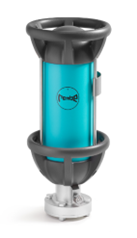
The Q-Bic extinguishing barrier from REMBE was developed in strict compliance with the hygiene requirements for spray-drying plants. Thanks to the convex dirt protection cap, neither water nor dust deposits can accumulate on the Q-Bic. The blue-green QXP extinguishing powder prevents cross-contamination and the patented SJX nozzle ensures optimum application of the extinguishing powder. The Q-Bic is particularly suitable for large pipes attached to dryers and filters or complex shaft geometries such as conveyors and elevators.
Picture3.png

Fig. 3: REMBE extinguishing barrier Q-Bic


Protection of spray dryers and cyclones – a case study

The task is to protect a spray dryer and a connected cyclone; the product is discharged via the cyclone.

The technical data at a glance:

  • Drying temperature: 90˚C
  • Dust specifications:
    • organic dust St1
    • KSt value: 150 bar*m/s
    • Pmax: 8 bar
    • lower explosion limit: 255g/m3
    • strength of all system elements: tested Pdesign of min. 0.3 bar

A safety concept is required that incorporates as few explosion safety products as possible. This is a common requirement; however, it can only be met by considering the plant as a whole and taking all technical specifications, as well as the latest research findings, into account.

In the present case, explosion isolation of the spray dryer from the cyclone is not necessary. At first glance, this contradicts the statement made earlier that isolation is absolutely necessary to prevent an explosion from propagating. However, scientific evidence shows that decoupling can be dispensed with if a Pred of max. 0.3 bar is determined for the entire plant, since any hazardous pre-compression in the neighbouring equipment can then be ruled out.

Protection for the spray dryer

VDI guideline 2263, or more precisely Sheet 7.1, states that under the following circumstances a reduced volume can be assumed when calculating the necessary vent areas / protective systems:

1.         No integrated fluid bed

2.         No recirculation of fine dust into the head of the spray dryer

3.         The average dust concentration inside the spray dryer is lower than the lower explosion limit of the dust.

If these three conditions are met, as in the present case, either a reduced volume of 1/3 of the total volume or the volume of the cone can be assumed. The larger volume must be selected in each case.

For the spray dryer in question, 1/3 of the total volume, i.e. 19.85 m3, was selected.

Observance of VDI guideline 2263, Sheet 7.1. allows an additional reduction in addition to the volume, resulting in smaller required vent areas. If it can be assumed that, due to the process, the optimum dust concentration for an explosion will never be present, the protective systems can be designed with a reduced KSt value. Due to the nature of the process – the product is to be dried after all – it has been scientifically proven that a maximum concentration of 250 g/m³ cannot occur in the spray drying system.

The inclusion of the latest research results and current guidelines in the design thus leads to a reduction in the volume to be considered and the KSt value. This in turn allows the creation of a safety concept that is not only safe but also cost-effective. By comparison, without taking these reductions into account, the vent areas for the spray dryer to be protected would have been up to 340% larger. From the operator's point of view, this is over-engineering, because larger relief areas always mean greater effort to modify the respective plant components and, last but not least, higher acquisition costs.

The following table shows how the protection system for the spray dryer under consideration might look with and without the described design requirements:

Protective systems in use

Conventional design

Design according to the latest research findings

Explosion vents, free venting to outside areas*

4 x EGV HYP hygienic explosion vents (586x920mm) (with EHEDG approval)

1 x EGV HYP hygienic explosion vent (586x920mm) (with EHEDG approval)

Flameless explosion venting

5 x Q-Box 586x920 with EGV HYP hygienic explosion vent

2 x Q-Box 586x920 with EGV HYP hygienic explosion vent

Combination of vent ducts and explosion vents

5 x EGV HYP hygienic explosion vents (586x920mm) (with EHEDG approval)

+ duct cover

1 x EGV HYP hygienic explosion vent (586x920mm) (with EHEDG approval)

+ duct cover

Suppression

3 x extinguishing agent bottles (45 l)

2 x extinguishing agent bottles (45 l)

* Rather unusual in the industry, as the plants are typically located inside buildings and "free" explosion venting is therefore not possible.

For round vessels such as spray dryers, selected flameless explosion venting systems, e.g. the Q-Box, can be installed by means of an adapter flange. Since the entire plant is located inside a building and the operator wanted an explosion protection system with the lowest possible maintenance requirements, flameless venting was chosen in this example.


Protection for the cyclone

For the associated cyclone, the original safety characteristics of the dust in question must be taken into account. Cyclones are usually vented via the vortex finder, which must be included in the design as a vent duct. Therefore, it is also crucial to know the exact dimensions of this plant component. In this particular case, the cyclone is protected by a DN 800 Q-Rohr equipped with an ERO hygienic explosion vent. By ensuring that the smooth surface of the explosion vent faces the processing area, all hygiene requirements from production are met.

The product discharge area below the cyclone is equipped with an explosion-proof and flame-proof rotary valve.


Risk of tampering with safety systems

Even the highest quality protective systems can only do their job if they are installed correctly and protected against tampering. The risk of tampering is an important issue, and also one that is sometimes ignored.

Recently, REMBE engineers have found indications of such deficiencies increasingly frequent during plant inspections:

For example, safety devices are disabled, electronic signalling and warning devices are bridged, mechanical elements are secured with too few fasteners and bolts. The reasons for this are complex and certainly not easy to understand.

The protective systems from renowned manufacturers such as REMBE are therefore designed from the ground up to ensure a high degree of in-built safety that is immune to tampering. For example, screw connections are replaced by non-detachable riveted connections; bolts are designed to be self-locking and captive.

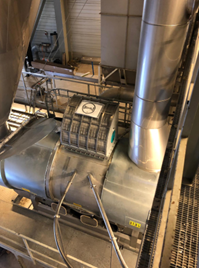
This is particular essential for more complex components such as devices for flameless venting. These systems are typically installed indoors, but always in locations where free venting, e.g. via explosion vents, is not possible. However, if the part responsible for flameless venting fails or has any weak points, this could have devastating consequences for the surrounding area, which would be left defenceless against the flames and pressure of an explosion.
Picture4.png

Fig. 4: REMBE Flameless venting on a fluidbed

www.rembe.de

No job is worth dying for – masks and how every face should fit

“In 2019, 1,082 workers per 100,000 were diagnosed with a work-related, respiratory condition many of which could have been prevented by a properly fitted mask,” says Mark Smith, technical director of Simon Safety who is also an accredited face fit tester. “Ten years earlier (1999), that number was 3,418 so we’ve come a long way but 1,082 per thousand is still too many. The majority of those workers work in hazardous engineering environments.


“Whichever way you look at it, that number is unacceptable. It’s criminal that lives are still being lost and compromised by people’s work. It’s criminal that our health service is having to treat patients who have been made sick by their work. And it’s criminal that some employers are still not taking their responsibilities seriously enough and may end up in prison for that negligence,” says Mark Smith.


HSE now on the face mask case


During Covid, the Health & Safety Executive visited circa 1,700 engineering businesses and gained a deep insight into the state of UK engineering sector’s health and safety.

Given how much attention face masks were given thanks to the Covid pandemic, you would think that people who use masks professionally would know how to wear them but that’s not the case from what the HSE saw in the engineering frontline.

More often than not, the HSE inspectors saw people wearing masks which weren’t the right size, weren’t the right fit, leaked all around, didn’t take into consideration both facial hair and how long they were being worn.

Engineers - and those responsible for their safety – thought it was OK to wear a mask for an entire job, no matter how long that job took ie several hours. A mask’s effectiveness decays fast once it becomes water-logged with condensation after prolonged wear. Masks need to be regularly refreshed to work efficiently.


Why so many masks are wrong


“There’s a hierarchy of control and respiratory control is at the bottom of that list, which means that your mask and other PPE is your last line of defence,” says Mark Smith of Simon Safety, which is a registered member of the British Safety Industry Federation (BSIF) and the Registered Safety Suppliers Scheme (RSSS).

“As soon as a toxin is inhaled, it’s in your system because that’s how breathing works.

“And if a mask doesn’t fit someone’s face - and we’re all different – it’s never going to protect you.”

Getting masks fit for purpose

In a Hazardous Engineering Solutions exclusive, Simon Safety shares a simple guide to help you stay safe – both employee and employer – if you follow four steps:

  • Get the right mask.
  • Fit the mask and train.
  • Maintain the mask.
  • Regularly review.

Step 1: Get the right mask


The right mask is the mask you’ve identified which meets your needs through a risk assessment.

Type of mask:

  • Disposable half masks.
  • Reusable half mask.
  • Full face masks.
  • Powered air purifying respirators (PAPR).
  • Breathing apparatus.

What’s right for the worker and their:

  • Type of task.
  • Face shape.
  • Physical build.
  • Facial features eg scars/warts.
  • Facial hair (only certain equipment will work with beards).

Does the mask need to work with:

  • Prescription spectacles (it’s the employer’s responsibility to ensure the operator’s spectacles fit inside the mask).
  • Eye protection.
  • Ear defenders.
  • Helmet/other head protection.

When several vulnerabilities need PPE – e.g. eyes, ears, head and respiratory – combined protection is best because it’s easier and faster to use which aids productivity. Where a combination of different items of PPE is used, it is the employer’s responsibility to ensure that the combination is effective.

What’s right for the work environment:

  • Duration of task e.g. how long will the task take? If the task involves wearing a close-fitting mask, the worker should take a break at least every hour. Different PPE is needed for day or night operation and inside or outside.
  • Work rate - does the task involve movement/perspiration? That may mean the mask could loosen over time.
  • Nature of the toxins – eg they may be flammable, explosive, aerosol, vapour, dust etc.

Your compliance obligations:

  1. Health and Safety at Work Act 1974.
  2. Fit testing is referred to in HSG53 – the HSE’s guide for employers to know (pages 19/20) and table 20 lists what type of mask employees need to wear.
  3. Fit testing brochure INDG479 – describes the methods you should use unless you have a process that’s as good or better. If you’re deviating from this guidance, you’ll need to prove good or better practice, which can be tricky so it’s usually best to stick to INDG479.

Step 2:  Fit the mask and train

A competent person must conduct the fit test.

Find out exactly how the HSE defines ‘competent’ on their website. It’s easier to prove that someone’s incompetent than to prove they are competent.

The HSE and the BSIF (British Safety Industry Federation) define ‘competence’ as an individual fit tester that has been accredited to the Fit2Fit scheme. Accredited testers have proven an extensive knowledge of respiratory protective equipment in conjunction with demonstrating a high level of competence in one or more of the accepted fit testing methods.


Quantitative test methods – eg in a lab test chamber or using a portable device, how effective is the mask at filtering contaminants? Does the performance comfortably exceed the minimum expected pass rate?

Qualitative test – eg wearing the mask under a testing hood, can you discern bitter vs sweet smell?

Does the mask fit?

Ask yourself: “Would I be happy for my nearest and dearest to work regularly in a hazardous environment with a mask that fits like this?”


Step 3: Maintain the mask

  • Every time you use it, check it over.
  • Before every use, perform a ‘fit check’ as shown during your formal fit test.
  • Closely inspect and keep a written record of the check at least once every month.

Step 4: Regularly review the mask and its fit

  • A competent person must conduct tests.
  • Follow the manufacturer’s instructions.
  • Appropriate frequency: when a person’s face changes eg due to significant weight gain/loss or significant dental work.
  • Recorded appropriately for the candidate’s training / HR records.
  • Remind everyone of best practice of properly fitting masks on notice boards so malpractice can be called out.
  • Review every one to two years to ensure all protection is suitable for the people and the environment.

Conclusion

In 2024, the Health & Safety at Work Act will be 50 years old.

The appeal from Mark Smith from Simon Safety: “We must all continue to learn from our mistakes if we’re to cut work-related respiratory illness and death in the hazardous engineering industry.

Independent and authoritative research suggests if your average DIYer breathes in a small amount of spray-paint, two weekends a year, it might have no detrimental impact. But if you’re doing that every working day, it has a cumulative effect. Slow and incremental daily doses often lead to debilitating chronic, long-term health conditions or can be killers and contribute to premature death,” says Mark Smith of Simon Safety.

“Today’s filtering technology means respiratory masks efficiently trap and protect your lungs from the smallest particles providing they fit correctly.

“The mistakes made in the past – such as the tragedy of asbestos – were due to ignorance. But we now know better. The internet puts all the appropriate information at our fingertips. It’s criminal not to act on it,” says Mark

“If you’re concerned about face masks or other piece of PPE call 01646 600750 or visit website. Take advantage of our expertise and let’s make 2024 a reason for celebration of how far we’ve come rather than regret.”

No job is worth dying for – masks and how every face should fit

“In 2019, 1,082 workers per 100,000 were diagnosed with a work-related, respiratory condition many of which could have been prevented by a properly fitted mask,” says Mark Smith, technical director of Simon Safety who is also an accredited face fit tester. “Ten years earlier (1999), that number was 3,418 so we’ve come a long way but 1,082 per thousand is still too many. The majority of those workers work in hazardous engineering environments.


“Whichever way you look at it, that number is unacceptable. It’s criminal that lives are still being lost and compromised by people’s work. It’s criminal that our health service is having to treat patients who have been made sick by their work. And it’s criminal that some employers are still not taking their responsibilities seriously enough and may end up in prison for that negligence,” says Mark Smith.


HSE now on the face mask case


During Covid, the Health & Safety Executive visited circa 1,700 engineering businesses and gained a deep insight into the state of UK engineering sector’s health and safety.

Given how much attention face masks were given thanks to the Covid pandemic, you would think that people who use masks professionally would know how to wear them but that’s not the case from what the HSE saw in the engineering frontline.

More often than not, the HSE inspectors saw people wearing masks which weren’t the right size, weren’t the right fit, leaked all around, didn’t take into consideration both facial hair and how long they were being worn.

Engineers - and those responsible for their safety – thought it was OK to wear a mask for an entire job, no matter how long that job took ie several hours. A mask’s effectiveness decays fast once it becomes water-logged with condensation after prolonged wear. Masks need to be regularly refreshed to work efficiently.


Why so many masks are wrong


“There’s a hierarchy of control and respiratory control is at the bottom of that list, which means that your mask and other PPE is your last line of defence,” says Mark Smith of Simon Safety, which is a registered member of the British Safety Industry Federation (BSIF) and the Registered Safety Suppliers Scheme (RSSS).

“As soon as a toxin is inhaled, it’s in your system because that’s how breathing works.

“And if a mask doesn’t fit someone’s face - and we’re all different – it’s never going to protect you.”

Getting masks fit for purpose

In a Hazardous Engineering Solutions exclusive, Simon Safety shares a simple guide to help you stay safe – both employee and employer – if you follow four steps:

  • Get the right mask.
  • Fit the mask and train.
  • Maintain the mask.
  • Regularly review.

Step 1: Get the right mask


The right mask is the mask you’ve identified which meets your needs through a risk assessment.

Type of mask:

  • Disposable half masks.
  • Reusable half mask.
  • Full face masks.
  • Powered air purifying respirators (PAPR).
  • Breathing apparatus.

What’s right for the worker and their:

  • Type of task.
  • Face shape.
  • Physical build.
  • Facial features eg scars/warts.
  • Facial hair (only certain equipment will work with beards).

Does the mask need to work with:

  • Prescription spectacles (it’s the employer’s responsibility to ensure the operator’s spectacles fit inside the mask).
  • Eye protection.
  • Ear defenders.
  • Helmet/other head protection.

When several vulnerabilities need PPE – e.g. eyes, ears, head and respiratory – combined protection is best because it’s easier and faster to use which aids productivity. Where a combination of different items of PPE is used, it is the employer’s responsibility to ensure that the combination is effective.

What’s right for the work environment:

  • Duration of task e.g. how long will the task take? If the task involves wearing a close-fitting mask, the worker should take a break at least every hour. Different PPE is needed for day or night operation and inside or outside.
  • Work rate - does the task involve movement/perspiration? That may mean the mask could loosen over time.
  • Nature of the toxins – eg they may be flammable, explosive, aerosol, vapour, dust etc.

Your compliance obligations:

  1. Health and Safety at Work Act 1974.
  2. Fit testing is referred to in HSG53 – the HSE’s guide for employers to know (pages 19/20) and table 20 lists what type of mask employees need to wear.
  3. Fit testing brochure INDG479 – describes the methods you should use unless you have a process that’s as good or better. If you’re deviating from this guidance, you’ll need to prove good or better practice, which can be tricky so it’s usually best to stick to INDG479.

Step 2:  Fit the mask and train

A competent person must conduct the fit test.

Find out exactly how the HSE defines ‘competent’ on their website. It’s easier to prove that someone’s incompetent than to prove they are competent.

The HSE and the BSIF (British Safety Industry Federation) define ‘competence’ as an individual fit tester that has been accredited to the Fit2Fit scheme. Accredited testers have proven an extensive knowledge of respiratory protective equipment in conjunction with demonstrating a high level of competence in one or more of the accepted fit testing methods.


Quantitative test methods – eg in a lab test chamber or using a portable device, how effective is the mask at filtering contaminants? Does the performance comfortably exceed the minimum expected pass rate?

Qualitative test – eg wearing the mask under a testing hood, can you discern bitter vs sweet smell?

Does the mask fit?

Ask yourself: “Would I be happy for my nearest and dearest to work regularly in a hazardous environment with a mask that fits like this?”


Step 3: Maintain the mask

  • Every time you use it, check it over.
  • Before every use, perform a ‘fit check’ as shown during your formal fit test.
  • Closely inspect and keep a written record of the check at least once every month.

Step 4: Regularly review the mask and its fit

  • A competent person must conduct tests.
  • Follow the manufacturer’s instructions.
  • Appropriate frequency: when a person’s face changes eg due to significant weight gain/loss or significant dental work.
  • Recorded appropriately for the candidate’s training / HR records.
  • Remind everyone of best practice of properly fitting masks on notice boards so malpractice can be called out.
  • Review every one to two years to ensure all protection is suitable for the people and the environment.

Conclusion

In 2024, the Health & Safety at Work Act will be 50 years old.

The appeal from Mark Smith from Simon Safety: “We must all continue to learn from our mistakes if we’re to cut work-related respiratory illness and death in the hazardous engineering industry.

Independent and authoritative research suggests if your average DIYer breathes in a small amount of spray-paint, two weekends a year, it might have no detrimental impact. But if you’re doing that every working day, it has a cumulative effect. Slow and incremental daily doses often lead to debilitating chronic, long-term health conditions or can be killers and contribute to premature death,” says Mark Smith of Simon Safety.

“Today’s filtering technology means respiratory masks efficiently trap and protect your lungs from the smallest particles providing they fit correctly.

“The mistakes made in the past – such as the tragedy of asbestos – were due to ignorance. But we now know better. The internet puts all the appropriate information at our fingertips. It’s criminal not to act on it,” says Mark

“If you’re concerned about face masks or other piece of PPE call 01646 600750 or visit website. Take advantage of our expertise and let’s make 2024 a reason for celebration of how far we’ve come rather than regret.”

No job is worth dying for – masks and how every face should fit

“In 2019, 1,082 workers per 100,000 were diagnosed with a work-related, respiratory condition many of which could have been prevented by a properly fitted mask,” says Mark Smith, technical director of Simon Safety who is also an accredited face fit tester. “Ten years earlier (1999), that number was 3,418 so we’ve come a long way but 1,082 per thousand is still too many. The majority of those workers work in hazardous engineering environments.


“Whichever way you look at it, that number is unacceptable. It’s criminal that lives are still being lost and compromised by people’s work. It’s criminal that our health service is having to treat patients who have been made sick by their work. And it’s criminal that some employers are still not taking their responsibilities seriously enough and may end up in prison for that negligence,” says Mark Smith.


HSE now on the face mask case


During Covid, the Health & Safety Executive visited circa 1,700 engineering businesses and gained a deep insight into the state of UK engineering sector’s health and safety.

Given how much attention face masks were given thanks to the Covid pandemic, you would think that people who use masks professionally would know how to wear them but that’s not the case from what the HSE saw in the engineering frontline.

More often than not, the HSE inspectors saw people wearing masks which weren’t the right size, weren’t the right fit, leaked all around, didn’t take into consideration both facial hair and how long they were being worn.

Engineers - and those responsible for their safety – thought it was OK to wear a mask for an entire job, no matter how long that job took ie several hours. A mask’s effectiveness decays fast once it becomes water-logged with condensation after prolonged wear. Masks need to be regularly refreshed to work efficiently.


Why so many masks are wrong


“There’s a hierarchy of control and respiratory control is at the bottom of that list, which means that your mask and other PPE is your last line of defence,” says Mark Smith of Simon Safety, which is a registered member of the British Safety Industry Federation (BSIF) and the Registered Safety Suppliers Scheme (RSSS).

“As soon as a toxin is inhaled, it’s in your system because that’s how breathing works.

“And if a mask doesn’t fit someone’s face - and we’re all different – it’s never going to protect you.”

Getting masks fit for purpose

In a Hazardous Engineering Solutions exclusive, Simon Safety shares a simple guide to help you stay safe – both employee and employer – if you follow four steps:

  • Get the right mask.
  • Fit the mask and train.
  • Maintain the mask.
  • Regularly review.

Step 1: Get the right mask


The right mask is the mask you’ve identified which meets your needs through a risk assessment.

Type of mask:

  • Disposable half masks.
  • Reusable half mask.
  • Full face masks.
  • Powered air purifying respirators (PAPR).
  • Breathing apparatus.

What’s right for the worker and their:

  • Type of task.
  • Face shape.
  • Physical build.
  • Facial features eg scars/warts.
  • Facial hair (only certain equipment will work with beards).

Does the mask need to work with:

  • Prescription spectacles (it’s the employer’s responsibility to ensure the operator’s spectacles fit inside the mask).
  • Eye protection.
  • Ear defenders.
  • Helmet/other head protection.

When several vulnerabilities need PPE – e.g. eyes, ears, head and respiratory – combined protection is best because it’s easier and faster to use which aids productivity. Where a combination of different items of PPE is used, it is the employer’s responsibility to ensure that the combination is effective.

What’s right for the work environment:

  • Duration of task e.g. how long will the task take? If the task involves wearing a close-fitting mask, the worker should take a break at least every hour. Different PPE is needed for day or night operation and inside or outside.
  • Work rate - does the task involve movement/perspiration? That may mean the mask could loosen over time.
  • Nature of the toxins – eg they may be flammable, explosive, aerosol, vapour, dust etc.

Your compliance obligations:

  1. Health and Safety at Work Act 1974.
  2. Fit testing is referred to in HSG53 – the HSE’s guide for employers to know (pages 19/20) and table 20 lists what type of mask employees need to wear.
  3. Fit testing brochure INDG479 – describes the methods you should use unless you have a process that’s as good or better. If you’re deviating from this guidance, you’ll need to prove good or better practice, which can be tricky so it’s usually best to stick to INDG479.

Step 2:  Fit the mask and train

A competent person must conduct the fit test.

Find out exactly how the HSE defines ‘competent’ on their website. It’s easier to prove that someone’s incompetent than to prove they are competent.

The HSE and the BSIF (British Safety Industry Federation) define ‘competence’ as an individual fit tester that has been accredited to the Fit2Fit scheme. Accredited testers have proven an extensive knowledge of respiratory protective equipment in conjunction with demonstrating a high level of competence in one or more of the accepted fit testing methods.


Quantitative test methods – eg in a lab test chamber or using a portable device, how effective is the mask at filtering contaminants? Does the performance comfortably exceed the minimum expected pass rate?

Qualitative test – eg wearing the mask under a testing hood, can you discern bitter vs sweet smell?

Does the mask fit?

Ask yourself: “Would I be happy for my nearest and dearest to work regularly in a hazardous environment with a mask that fits like this?”


Step 3: Maintain the mask

  • Every time you use it, check it over.
  • Before every use, perform a ‘fit check’ as shown during your formal fit test.
  • Closely inspect and keep a written record of the check at least once every month.

Step 4: Regularly review the mask and its fit

  • A competent person must conduct tests.
  • Follow the manufacturer’s instructions.
  • Appropriate frequency: when a person’s face changes eg due to significant weight gain/loss or significant dental work.
  • Recorded appropriately for the candidate’s training / HR records.
  • Remind everyone of best practice of properly fitting masks on notice boards so malpractice can be called out.
  • Review every one to two years to ensure all protection is suitable for the people and the environment.

Conclusion

In 2024, the Health & Safety at Work Act will be 50 years old.

The appeal from Mark Smith from Simon Safety: “We must all continue to learn from our mistakes if we’re to cut work-related respiratory illness and death in the hazardous engineering industry.

Independent and authoritative research suggests if your average DIYer breathes in a small amount of spray-paint, two weekends a year, it might have no detrimental impact. But if you’re doing that every working day, it has a cumulative effect. Slow and incremental daily doses often lead to debilitating chronic, long-term health conditions or can be killers and contribute to premature death,” says Mark Smith of Simon Safety.

“Today’s filtering technology means respiratory masks efficiently trap and protect your lungs from the smallest particles providing they fit correctly.

“The mistakes made in the past – such as the tragedy of asbestos – were due to ignorance. But we now know better. The internet puts all the appropriate information at our fingertips. It’s criminal not to act on it,” says Mark

“If you’re concerned about face masks or other piece of PPE call 01646 600750 or visit website. Take advantage of our expertise and let’s make 2024 a reason for celebration of how far we’ve come rather than regret.”

No job is worth dying for – masks and how every face should fit

“In 2019, 1,082 workers per 100,000 were diagnosed with a work-related, respiratory condition many of which could have been prevented by a properly fitted mask,” says Mark Smith, technical director of Simon Safety who is also an accredited face fit tester. “Ten years earlier (1999), that number was 3,418 so we’ve come a long way but 1,082 per thousand is still too many. The majority of those workers work in hazardous engineering environments.


“Whichever way you look at it, that number is unacceptable. It’s criminal that lives are still being lost and compromised by people’s work. It’s criminal that our health service is having to treat patients who have been made sick by their work. And it’s criminal that some employers are still not taking their responsibilities seriously enough and may end up in prison for that negligence,” says Mark Smith.


HSE now on the face mask case


During Covid, the Health & Safety Executive visited circa 1,700 engineering businesses and gained a deep insight into the state of UK engineering sector’s health and safety.

Given how much attention face masks were given thanks to the Covid pandemic, you would think that people who use masks professionally would know how to wear them but that’s not the case from what the HSE saw in the engineering frontline.

More often than not, the HSE inspectors saw people wearing masks which weren’t the right size, weren’t the right fit, leaked all around, didn’t take into consideration both facial hair and how long they were being worn.

Engineers - and those responsible for their safety – thought it was OK to wear a mask for an entire job, no matter how long that job took ie several hours. A mask’s effectiveness decays fast once it becomes water-logged with condensation after prolonged wear. Masks need to be regularly refreshed to work efficiently.


Why so many masks are wrong


“There’s a hierarchy of control and respiratory control is at the bottom of that list, which means that your mask and other PPE is your last line of defence,” says Mark Smith of Simon Safety, which is a registered member of the British Safety Industry Federation (BSIF) and the Registered Safety Suppliers Scheme (RSSS).

“As soon as a toxin is inhaled, it’s in your system because that’s how breathing works.

“And if a mask doesn’t fit someone’s face - and we’re all different – it’s never going to protect you.”

Getting masks fit for purpose

In a Hazardous Engineering Solutions exclusive, Simon Safety shares a simple guide to help you stay safe – both employee and employer – if you follow four steps:

  • Get the right mask.
  • Fit the mask and train.
  • Maintain the mask.
  • Regularly review.

Step 1: Get the right mask


The right mask is the mask you’ve identified which meets your needs through a risk assessment.

Type of mask:

  • Disposable half masks.
  • Reusable half mask.
  • Full face masks.
  • Powered air purifying respirators (PAPR).
  • Breathing apparatus.

What’s right for the worker and their:

  • Type of task.
  • Face shape.
  • Physical build.
  • Facial features eg scars/warts.
  • Facial hair (only certain equipment will work with beards).

Does the mask need to work with:

  • Prescription spectacles (it’s the employer’s responsibility to ensure the operator’s spectacles fit inside the mask).
  • Eye protection.
  • Ear defenders.
  • Helmet/other head protection.

When several vulnerabilities need PPE – e.g. eyes, ears, head and respiratory – combined protection is best because it’s easier and faster to use which aids productivity. Where a combination of different items of PPE is used, it is the employer’s responsibility to ensure that the combination is effective.

What’s right for the work environment:

  • Duration of task e.g. how long will the task take? If the task involves wearing a close-fitting mask, the worker should take a break at least every hour. Different PPE is needed for day or night operation and inside or outside.
  • Work rate - does the task involve movement/perspiration? That may mean the mask could loosen over time.
  • Nature of the toxins – eg they may be flammable, explosive, aerosol, vapour, dust etc.

Your compliance obligations:

  1. Health and Safety at Work Act 1974.
  2. Fit testing is referred to in HSG53 – the HSE’s guide for employers to know (pages 19/20) and table 20 lists what type of mask employees need to wear.
  3. Fit testing brochure INDG479 – describes the methods you should use unless you have a process that’s as good or better. If you’re deviating from this guidance, you’ll need to prove good or better practice, which can be tricky so it’s usually best to stick to INDG479.

Step 2:  Fit the mask and train

A competent person must conduct the fit test.

Find out exactly how the HSE defines ‘competent’ on their website. It’s easier to prove that someone’s incompetent than to prove they are competent.

The HSE and the BSIF (British Safety Industry Federation) define ‘competence’ as an individual fit tester that has been accredited to the Fit2Fit scheme. Accredited testers have proven an extensive knowledge of respiratory protective equipment in conjunction with demonstrating a high level of competence in one or more of the accepted fit testing methods.


Quantitative test methods – eg in a lab test chamber or using a portable device, how effective is the mask at filtering contaminants? Does the performance comfortably exceed the minimum expected pass rate?

Qualitative test – eg wearing the mask under a testing hood, can you discern bitter vs sweet smell?

Does the mask fit?

Ask yourself: “Would I be happy for my nearest and dearest to work regularly in a hazardous environment with a mask that fits like this?”


Step 3: Maintain the mask

  • Every time you use it, check it over.
  • Before every use, perform a ‘fit check’ as shown during your formal fit test.
  • Closely inspect and keep a written record of the check at least once every month.

Step 4: Regularly review the mask and its fit

  • A competent person must conduct tests.
  • Follow the manufacturer’s instructions.
  • Appropriate frequency: when a person’s face changes eg due to significant weight gain/loss or significant dental work.
  • Recorded appropriately for the candidate’s training / HR records.
  • Remind everyone of best practice of properly fitting masks on notice boards so malpractice can be called out.
  • Review every one to two years to ensure all protection is suitable for the people and the environment.

Conclusion

In 2024, the Health & Safety at Work Act will be 50 years old.

The appeal from Mark Smith from Simon Safety: “We must all continue to learn from our mistakes if we’re to cut work-related respiratory illness and death in the hazardous engineering industry.

Independent and authoritative research suggests if your average DIYer breathes in a small amount of spray-paint, two weekends a year, it might have no detrimental impact. But if you’re doing that every working day, it has a cumulative effect. Slow and incremental daily doses often lead to debilitating chronic, long-term health conditions or can be killers and contribute to premature death,” says Mark Smith of Simon Safety.

“Today’s filtering technology means respiratory masks efficiently trap and protect your lungs from the smallest particles providing they fit correctly.

“The mistakes made in the past – such as the tragedy of asbestos – were due to ignorance. But we now know better. The internet puts all the appropriate information at our fingertips. It’s criminal not to act on it,” says Mark

“If you’re concerned about face masks or other piece of PPE call 01646 600750 or visit website. Take advantage of our expertise and let’s make 2024 a reason for celebration of how far we’ve come rather than regret.”

Hazards 32

Hazards 32
18–20 October 2022, Harrogate, UK


The Institution of Chemical Engineers’ (IChemE) annual Hazards conference returns in person this year, taking place in Harrogate, UK on 18–20 October.

Hazards 32 will help to advance the understanding of and application of managing major hazards and provide valuable networking opportunities. This industry-focused event is aimed at anyone who is active in process safety and hazard management for chemical process facilities or other facilities dealing with hazardous materials, at all levels and in all sectors.

What to expect from Hazards 32

The programme features over 80 technical presentations from industry practitioners, researchers and regulators covering a wide range of topics in the functional areas that are key to managing and reducing process safety risk effectively. Presentations will share examples of good practice, new approaches and valuable lessons learned in process safety and hazard management that attendees can transfer to their own operations, as well as exploring the emerging challenges and major hazard implications of new technologies and applications. There will also be a workshop on bowties delivered by Gold Sponsor, Wolters Kluwer.

Facilitated discussion time has been built into the programme to encourage attendees to share experiences and learn from each other, whilst helping to identify the common issues facing industry practitioners. There will also be a panel discussion where attendees can share their thoughts on meeting the major process safety challenges in industry.

Speaker line-up

The programme includes contributions from key international players in the process industries including Atkins, DEKRA, INEOS, Sellafield Ltd, Shell, the Health and Safety Executive, Wood and many, many more.

The technical presentations will be complemented by an impressive line-up of plenary speakers. Dame Judith Hackitt will speak on the challenges of learning lessons in the industry and the importance of ethics in engineering during a lecture created to honour the memory of process safety pioneer, Trevor Kletz. Joining Hackitt are various leaders within the major hazards industry. Jane Lassey, Director of the Health and Safety Executive’s Chemicals, Explosives and Microbiological Hazards Division, and Michelle Roberson, General Manager, Process Safety at Shell, US will explore the emerging challenges in hazard management; Lassey from a regulatory perspective, and Roberson from the viewpoint of the operator making the energy transition. The Tank Storage Association’s Executive Director, Peter Davidson, will present on the role of leadership in managing major hazards. Jasper Clark, Risk Engineering Hub Leader at Marsh Energy & Power, will share insights from an insurance industry perspective on turning good practice into common practice. And the Chemical Industry Association’s Chief Executive, Steve Elliott, will present on the importance of cross-sector learning.

Trade exhibition and industry support

A trade exhibition will run alongside the conference, showcasing products and services to support the major hazards community. Several leading companies in the industry are sponsoring Hazards 32 including Wolters Kluwer, BakerRisk, ESR Technology, MES and ABS Group. There are more packages available to suit all budgets, and companies interested in sponsoring or exhibiting at Hazards 32 can learn about the opportunities that are available on the event website.

Networking opportunities

Hazards was last held in-person in May 2019. Virtual conferences have continued to facilitate knowledge-transfer and learning since, but they couldn’t replicate the valuable networking opportunities available at an in-person event. This year’s in-person event offers the chance for the major hazards community to rebuild networks and make new contacts, with plenty of social and networking time built into the programme.

To view the Hazards 32 programme and register to attend on 18–20 October, visit www.icheme.org/hazards32

Hazards 32 in summary

·         Technical presentations from industry, regulators and researchers

·         Inspiring plenary speakers

·         Facilitated discussion and Q&A

·         Panel discussion

·         Trade exhibition

·         Social and networking opportunities


Midas Safety First sustainability report for the year of 2021

Midas Safety, the safety solutions company, has today published its first sustainability report for the year 2021, which documents its progress towards better management of its economic, environmental and social impacts and commitment to “Making Safety Sustainable”.

Please click the link to read the report

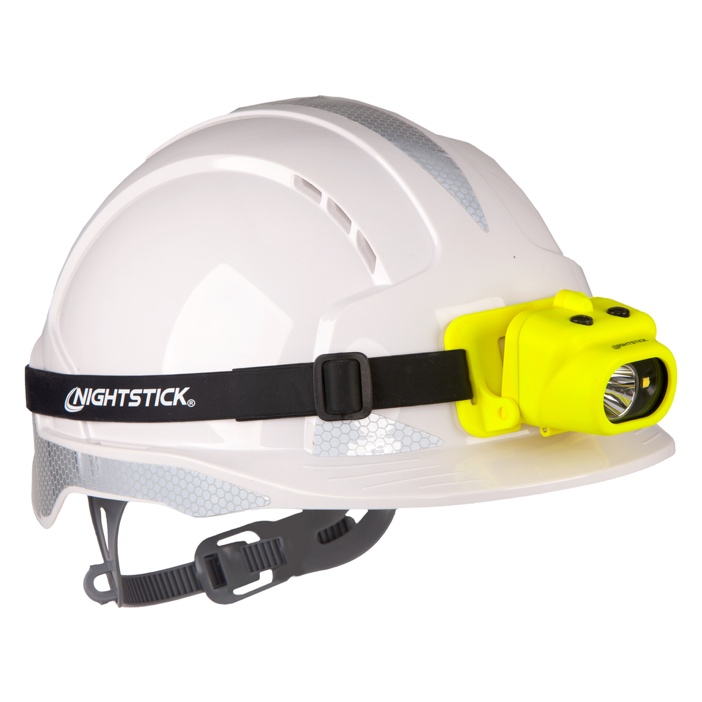
The Differences Between Intrinsically Safe and Explosion-Proof

When the time comes to purchase safety lighting, it is vital to understand the difference between Explosion-Proof (Ex) and Intrinsically Safe (IS) lighting products. 

What does Explosion-Proof mean?

EX and IS equipment are both certified by nationally recognized testing laboratories for use in hazardous areas, but there are some key differences. EX lighting is typically built using heavy enclosures made from rugged materials such as stainless steel or aluminum alloys, and EX equipment is designed to both contain an explosion and survive an explosion. 

What does Intrinsically Safe mean?

IS equipment is designed to prevent an explosion rather than contain it. It is light weight and limits the energy and temperature in the device to prevent it from producing a spark or reaching a temperature that could ignite a hazardous environment. Using the IS protection method is why these devices require much lower energy levels than EX-protected equipment.

IS and EX are often used interchangeably but are entirely different in how they work. EX contains the explosion and releases the resulting gases from the device at a safe temperature but IS devices reduce the risk of explosion by managing available energy, which eliminates sparks and thermal effects in a hazardous environment before they happen.

Other benefits of IS equipment are cost savings, reduced weight, and portability. The quality of IS equipment is vital in potentially explosive environments, and one must ensure their lighting is manufactured by a reputable company with documented experience in creating IS products. Because of the knowledge, time, and expense required to engineer and produce IS products, a very limited number of companies can achieve this.

Nightstick is a global manufacturer of IS portable LED lighting products that exceed industry standards in performance, quality, and user safety. From penlights to floodlights, above ground or below ground, Nightstick has you covered. Focus on completing your job with confidence, knowing your equipment was designed and rated for the highest safety levels.

When Life Depends on LightTM, choose Nightstick! Visit nightstick.com for more information

DuPont Joins Forces with Heriot-Watt University to Develop PPE for a Changing Workforce

DuPont (NYSE:DD) has partnered with a leading UK fashion design university to develop Personal Protection Equipment (PPE) that is fit for today’s changing workforce. The collaboration between Heriot-Watt University’s School of Textiles and Design and DuPont Personal Protection aims to innovate protective clothing in line with evolving worker needs. 

The demographic makeup of the workforce is evolving. The share of European women in employment rose from just over 58% in 2009 to over 64% ten years later,[1] and is continuing to grow[2]. The workforce is also undergoing demographic ageing (1 in 5 workers in the EU are over 55[3]) and is becoming more diverse due to migration[4]. These trends call for a new approach to PPE design that maximises variety, comfort, and ease of use. This is where DuPont’s collaboration with Heriot-Watt University comes in.

 “We are committed to continuing innovating our materials and PPE design to address the changing needs of workers around the world,” comments Valérie Pierret, Global Market Development Leader, DuPont Personal Protection. “We decided to join forces with one of the leading fashion and textile research institutions in Europe to bring new, disruptive ideas to our garment design process.” 

The project already generated over 500 pages filled with ideas, more than 20 prototype concepts and preliminary evaluations of the performance of the concepts.

The School of Textiles and Design, located in Galashiels (Scotland), is a centre of excellence for fashion, design and textiles that brings together talented students from across the globe.

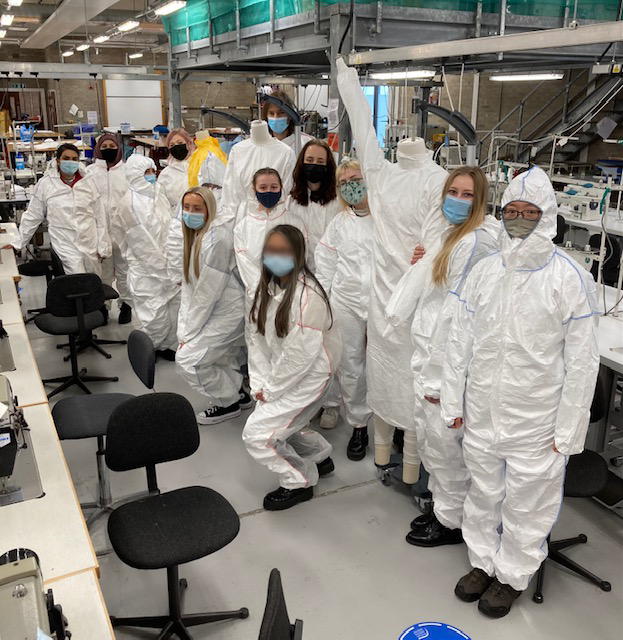
The partnership between the School and DuPont paved the way for a new research project involving a group of around 20 students and led by industrial and fashion technology expert, Assistant Professor Bruce Munro Roberts.

“Working on this collaborative project with DuPont provided the BSc Fashion Technology students with real life industry experience,” comments Roberts. “The support for the students in terms of learning materials, sample PPE, fabrics and feedback exceeded our expectations, and overall, we were delighted to be working with this international company”.

DuPont provided the team with a thorough overview of its current solutions, relevant market information including voice of customer research findings and key regulatory requirements for PPE. With this information at hand, the students then received a detailed brief, including information on target applications, specific parameters for success, key requirements and desired deliverables.

The students quickly got up to speed with the subject and took inspiration from sportswear and outerwear to develop innovative PPE design solutions. 

“I was amazed by the volume and quality of the ideas the students were able to generate,” comments Pierret. “Despite the challenging task they faced, the students were able to think outside of the box while complying with the stringent requirements that PPE typically entails.”

A panel of DuPont experts reviewed the project and selected three concepts, which will be implemented in existing and new product designs. DuPont will continue collaborating with Heriot-Watt University on new design projects to continue innovating PPE.  

www.dupont.com


NightStick expert content series


NIGHTSTICK ,

Life Depends on it 

EXPERT CONTENT SERIES 

Common Intrinsically Safe questions answered 

By Derek Box Marketing Manager of NightStick 

click the below for more Common Intrinsically Safe questions answered 

Nightstick Expert Content series