Find ATEX, IECEx, Explosion Protection & Hazardous Area Content...

News

RHEINTACHO expands sales team Stefan Lenz appointed new branchmanager

Mr. Stefan Lenz has been the new business manager at the Freiburg family company RHEINTACHO Messtechnik GmbH since October 2022. This increases the capacity and competence in sales around Wolfgang Sexauer's team.

In order to increase RHEINTACHO´s markets and to take care for the growing customer portfolio, Stefan Lenz will strengthen the RHEINTACHO branch management alongside his colleagues Thomas Distel and Jörn Strasser.

In the last 12 years, Stefan Lenz has worked successfully in the field sales force and has gotten to know and gained a lot of experience from groups to family businesses. He will now be able to use the knowledge he has acquired in technical sales when dealing with our customers. Through various commercial, technical and sales training courses in sales, he is an enrichment and we warmly welcome Stefan Lenz to our team.


https://www.rheintacho.de/en/news-events/events/

Bearing Lubrication Reimagined: Remote and Real Time Friction Monitoring and Lubrication

What if we could lubricate our bearings remotely, from any device, making sure that the right amount and right lubricant are always used – and even better, based on bearing condition? Then we would address the 3 main lubrication issues which cause most of early bearing failures. Today this is already possible. Using ultrasonic sensors and single point lubrication devices, all connected to a central system, we can now bring lubrication practices to a whole new level!

Prevention in place of monitoring

We have a serious problem with bearing condition monitoring! Technology is making it easier and more cost-effective to monitor our bearings in real-time and as a result, we are seeing sensors and systems being installed on equipment at an exponential rate.  

There is a race from these monitoring systems to detect the onset of failure (Point P on the P-F curve) at the earliest possible point. And this race to detect a failure is a serious problem. We are spending more money and extra TIME to detect a failure when we should be preventing that failure in the first place.   

Addressing lubrication issues – the root of most bearing failures

It is no secret that over 80% of premature bearings failures can be traced back to lubrication related issues. These issues can be put into three general categories: inadequate lubrication (over or under lubricated), wrong lubricant, and contamination. When it comes to addressing premature bearing failure, reducing the impact on just one of these issues can have a large impact on the bearing life. But when we start to address all three, then we canreach excellence in our lubrication programs.

It’s all about the friction levels

A lot of expertise needs to be designed into the bearing selection and lubrication requirements, no technology will likely ever replace the need for trained and experienced lubrication experts.But when it boils down to it, it is all about friction - that’s why they are called anti-friction bearings.

Once the correct bearing is installed properly and the right lubricant is chosen, it comes down to managing that friction in the bearing by using the correct regreasing volume and frequency. Simple to understand but often difficult to put intopractice.

Time based lubrication vs condition-basedusing ultrasound to avoid under and over-lubrication

One technique is to use time-based lubrication. In this case, regreasing is done based on time, with a predetermined amount of grease. This method is often based on an ideal calculation that is not reflective of the real-life condition that influences the friction in the bearing. This often leads to under greasing or over greasing the bearing.

A step-change in lubrication practices came with condition-based lubrication. Using ultrasound to measure the friction in real-time to determine exactly when lubrication (and how much)is required to bring the friction back to or near the ideal level. Moving to ultrasound-assisted lubrication will ensure we do not over or under lubricate but has still not addressed the two other lubrication related issues: using the correct lubricant, and contamination.

What about automatic lubricators?

To address these two other lubrication issues many have turned to automatic lubrication devices or auto lubers. Automatic lubrication provides a safer and more convenient method of supplying the precise amount of lubricant into the bearings on a more frequent basis.

These devices ensure we always use the correct grease stored in the device but also reduce or eliminate the possibility of contamination caused by the operational environment. These devices are time-based and set to dispense lubricant on a set frequency or run time.

The auto lubricant devices have evolved to become smarter. Many of them not only dispense the lubricant but can also set alarms based on excessive feedback and low lubricant.

The best of two worlds: SmartLube – single point lubricator, remotely operated, based on friction levels

We have two solutions addressing the different aspects of the common lubrication issues. On one side we have ultrasound-assisted lubrication, using friction to determine when and how much lubrication is required. Combined with good lubrication practices, it will provide benefits but still requires an investment in time and training to ensure the proper lubricant is used to reduce the potential of contamination.

On the other side, we have automatic lubrication devices ensuring the correct, contaminant-free lubricant but still based on time or running hours versus the condition or friction in the bearing, often still leading to not optimizing lubrication frequency.

What if we were able to combine the proven precision and best practice of condition-based lubrication using ultrasound with the convenience, safety, and accuracy of automatic lubrication devices? We would then have a solution that allows us to lubricate our bearings only when required by measuring friction and ensuring we always use the correct, contaminant-free lubricant every time. That’s exactly what the SmartLube from UE Systems does.

Lubricate based on friction, from any device, anywhere

When we use technology to make all this remotely operated, we can now monitor the real-time friction of our bearings and, when needed, remotely dispense the correct lubricant. All this with theconfidence that the lubricant is getting to the bearing with real-time alerts and notifications from any internet-connected device, anywhere in the world!  

The OnTrak SmartLube by UE Systems has the power of real-time bearing friction monitoring and the convenience, safety, and accuracy of single-point bearing lubricators. Lubrication experts can now lubricate remotely with confidence from anywhere, anytime, on any device.

How does it work?  

This disruptive device works with a simple concept: ultrasonic sensors are permanently mounted on the bearings to monitor friction levels. All this data is sent to a central processing unit – the OnTrak – and can be viewed in dashboards using any internet-connected device. The OnTrak then is also connected to single point lubrication devices. Based on the friction levels and on setup alarms, we now have the possibility to tell the OnTrakthat a certain bearing needs lubricant. The OnTrak will then instruct the SmartLube – single point lubricator – to dispense lubricant, just the right amount. And the best part: all can be done remotely, anywhere, anytime.

www.uesystems.com



EEMUA- LIVE WEBINAR TODAY 15TH OF NOVEMBER 2022

On TODAY – **EEMUA 168 A guide to pressure testing of equipment Edition 3 – WEBINAR – 15 November 2022 ** –– live online – FREE to all – 1-hour focus from 15:00 UK time covers extended scope of EEMUA 168 Edition 3: full lifecycle of pressure testing, competency, how to perform pressure tests safely. The session will share experience applying the EEMUA 168 competency framework in manufacturing and process sides. Please find more details and registration at –.  

Please find your copy of EEMUA 168 Guide to pressure testing of equipment Edition 3 at https://bit.ly/3sksR5B and e-learning that complements the guide athttps://bit.ly/3TNF5iZ 

EEMUA, the not-for-profit industry association, has many more resources for the industrial engineering community – please This email address is being protected from spambots. You need JavaScript enabled to view it. how to make those resources work best for you and your team. 

#eemua168 #pressuretesting #freewebinar 

UKCA labelling easement

The government intends to introduce legislation enabling the UKCA marking to be placed on a label affixed to the product or on a document accompanying the product until 11pm on 31 December 2027. This measure will apply to the following regulations:

  • Aerosol Dispensers Regulations 2009
  • Electrical Equipment (Safety) Regulations 2016
  • Electromagnetic Compatibility Regulations 2016
  • Explosives Regulations 2014
  • Equipment and Protective Systems Intended for Use in Potentially Explosive Atmospheres Regulations 2016
  • Lifts Regulations 2016
  • Measuring Container Bottles (EEC Requirements) Regulations 1977
  • Measuring Instruments Regulations 2016
  • Noise Emission in the Environment by Equipment for use Outdoors Regulations 2001
  • Non-automatic Weighing Instruments Regulations 2016
  • Pyrotechnic Articles (Safety) Regulations 2015
  • Radio Equipment Regulations 2017
  • Recreational Craft Regulations 2017
  • Regulation (EU) 2016/425 and the Personal Protective Equipment (Enforcement) Regulations 2018
  • Simple Pressure Vessels (Safety) Regulations 2016
  • Supply of Machinery (Safety) Regulations 2008
  • The Pressure Equipment (Safety) Regulations 2016
  • The Restriction of the Use of Certain Hazardous Substances in Electrical and Electronic Equipment Regulations 2012
  • Toys (Safety) Regulations 2011

There are different rules for medical devices, construction products, cableways, transportable pressure equipment, unmanned aircraft systems, rail products and marine equipment.

read more about UKCA development on the government website.

https://www.gov.uk/guidance/using-the-ukca-marking

GSME and HOTSPOT detector Early detection of explosions + fires


3A17D1AF-D701-462A-B953-8E3683156ADD.jpeg

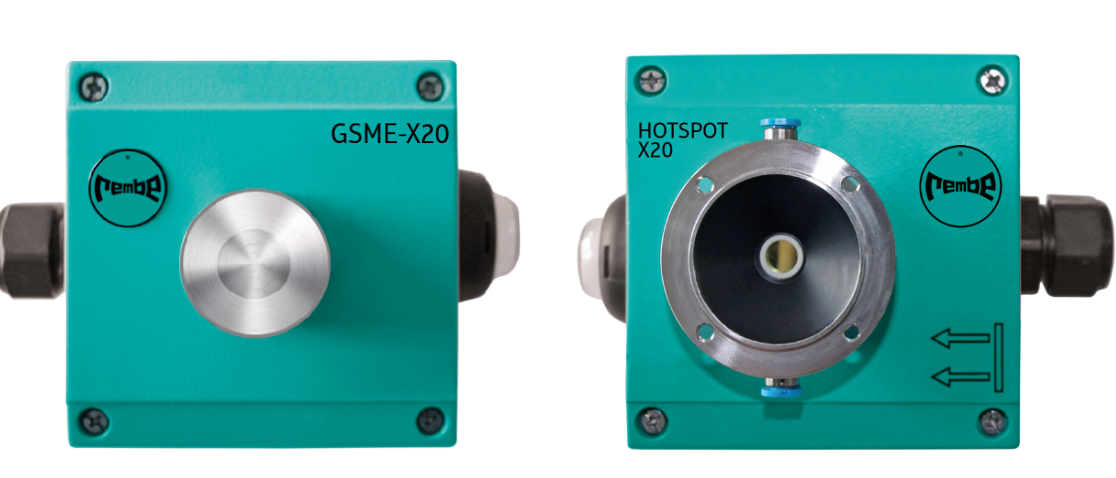
With the GSME and HOTSPOT detectors from REMBE, an artificial intelligence has been created that detects fire and explosion events at an early stage. The GSME detector is an artificial nose, "trained" for pyrolysis - popularly known as smoldering gases, while the HOTSPOT detector represents an artificial eye that already detects surface temperature changes of 1 ° C.

REMBE´s HOTSPOT X20 measures surface temperatures using an intelligent evaluation system, which divides the field of view into detection zones. A separate temperature threshold value can be set for each individual zone in order to tailor the detection to the process as far as possible. The HOTSPOT X20 can even identify small temperature increases (1°C) and enables to warn the operator of a fire or glowing embers at extremely early stages. The HOTSPOT X20 can also be used in explosion atmosphere up to zone 20 and under high dust loads and monitors a temperature range in the standard version of 0-200°C (higher temperatures possible, but typically not required).

Mainly hydrocarbon compounds are released when many substances thermally decompose. If there is incomplete burning without a flame and a low oxygen supply, carbon monoxide is created as well. The GSME X20 pyrolysis gas detector, for instance, has been designed for detecting these gases, even as they develop. Alongside carbon monoxide and hydrocarbon compounds, nitrogen oxide and hydrogen compounds (CO, HC, H2 and NOx) are also monitored. With the aid of an intelligent evaluation algorithm, a process behaviour can be ideally mapped and normal off-gasing be adopted. If a concentration increases above the usual level, the GSME X20 immediately triggers an alarm. The detectoris also suitable for explosion atmospheres up to zone 20, monitors concentration ranges from 0-100ppm.

When the location and mounting position are ideally designed in an explosion protection concept, HOTSPOT X20 and GSME X20 allow explosions and fires to be prevented through early detection.

CF5B0825-B432-4CD6-AAF3-6903DAA8FD57.jpeg

Fig1: GSME und HOTSPOT detector

About REMBE – the REMBE Alliance introduces itself

Most people associate REMBE with REMBE GmbH Safety+Control, the specialist for explosion safety and explosion venting worldwide. The company offers customers cross-industry safety concepts for plants and equipment. All products are manufactured in Germany and meet the requirements of national and international regulations. REMBE customers include market leaders in various industries, including the food, timber, chemical and pharmaceutical industries.

The company’s engineering expertise is based on almost 50years of application and project experience. As an independent, owner-managed family business, REMBE combines expertise with the highest quality standards and is involved in various specialist committees worldwide. Short coordination paths allow for quick reactions and customer-specific solutions for all applications, from standard products to high-tech special designs.

In addition to REMBE GmbH Safety+Control(www.rembe.de) with approx. 340 employees worldwide, headquartered in Brilon (Hochsauerland, Germany), and numerous subsidiaries worldwide (Italy, Finland, Brazil, USA, China, Dubai, Singapore, South Africa, Japan), four other companies operate under the REMBE umbrella brand:

• REMBE Research+TechnologyCenter GmbH (www.rembe-rtc.de)
• REMBE Advanced Services+Solutions GmbH (www.rembe-services.de)
• REMBE Kersting GmbH (www.rembe-kersting.de)
• REMBE FibreForce GmbH (www.argusline.de)

This article was Also featured in the November/December issue below 
 

Teledyne FLIR, Teledyne FLIR Announces FLIR ONE Edge Pro - The First Truly Wireless Mobile Infrared Camera


Detachable form factor is ideal for inspecting hard-to-reach places
 

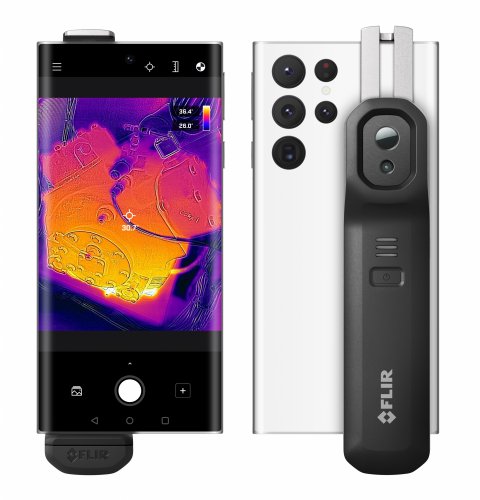
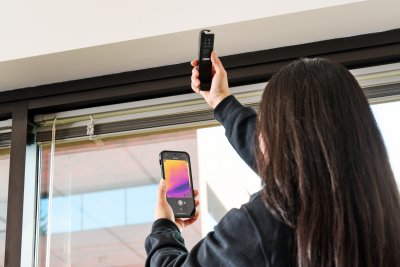
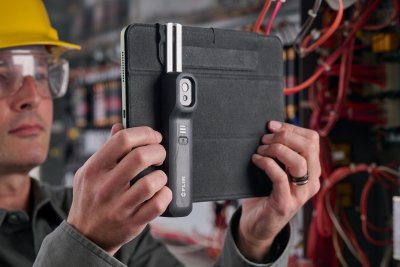
Teledyne FLIR, part of Teledyne Technologies Incorporated, today announced its FLIR ONE® Edge Pro, a wireless thermal-visible camera for mobile devices. Unlike previous models, the reimagined FLIR ONE Edge Pro doesn’t need to be physically connected to its companion mobile device nor does it have separate models for specific operating systems, providing maximum flexibility for thermal inspections.


“The FLIR ONE Edge Pro is the most versatile and advanced thermal-visible mobile camera yet thanks to its detachable form factor, designed to fit comfortably in your hand. It offers significantly greater flexibility by eliminating the need for specific connection ports or operating systems,” said Chris Bainter, vice president of marketing and business development, Teledyne FLIR. “In addition to the new hardware design, Teledyne FLIR is providing more software tools to empower new and untrained users to conduct thermography inspections, process images, and create reports. Common uses range from building inspection and auto repair to industrial maintenance applications.”

Flexible Yet Rugged Design

The “RESNET” compliant and IP54-rated FLIR ONE Edge Pro has a spring-loaded clip designed to allow operators to attach the camera to many types of mobile phones and tablets. Thanks to the combined Bluetooth and Wi-Fi connection, users can operate the Edge Pro up to 30 meters away from their mobile device, providing the flexibility to effectively inspect hard-to-reach places or those scenarios requiring greater standoff distances to maintain operator safety.  

Offering effective image quality and processing to deliver results, the FLIR ONE Edge Pro features a 160×120 resolution radiometric Lepton® thermal imaging camera paired with a visible camera. Along with VividIR, which combines multiple image frames to deliver one sharper, final image, the cameras are brought together via MSX®. The MSX patented image enhancement feature overlays the edge detail of the visible camera onto the thermal image without sacrificing any thermal data within the image, providing greater context and clarity to improve decision support.


The FLIR ONE Edge Pro also features an extended battery life compared to previous generations of the FLIR ONE and an easily-recognized battery life indicator, making it ideal for more prolonged inspection situations including disaster restoration, home inspection, energy auditing, and industrial equipment diagnostics. 

More image processing and reporting 
For cloud storage, imaging processing, and reporting, the FLIR ONE Edge Pro benefits from a rich set of Teledyne FLIR software including Tools Mobile, Ignite cloud, and FLIR Thermal Studio desktop software. This allows users to easily share Edge thermal photos with clients and seamlessly integrate them into professional reports.


Additionally, app developers have access to the FLIR ONE software development kit (SDK) to create custom applications for exclusive use with the FLIR ONE Edge Pro. 

Available for order worldwide starting November 10, visit www.flir.com/FLIRONE-EdgePro for more details and global availability.
 

Gearing up for ExpoProtection 2022


Global safety manufacturer MSA Safety is getting ready to showcase its market leading safety products at this year’s ExpoProtection event in Paris, from 15th to 17th November 2022.


Expoprotection is an international event that brings together all aspects of risk management, from professional and industry, to security and firefighting. With a large focus on safety, it is the perfect platform for MSA to bring to life its latest innovations when it comes to protecting people while they work in difficult environments such as construction or utilities.


MSA has built a legacy of safety innovation and best-in-class solutions across fall protection, head protection and gas detection. The company will be using the Paris event to demonstrate its capabilities across these sectors and to engage and network with industry peers.


Having recently launched new innovations in both the head and fall protection markets, visitors will get to see, feel and experience a wide portfolio of products, including the V-Series™ safety harnesses and lifelines and the V-Gard® range of industrial hard hats and accessories.  Also on display will also be MSA’s range of portable gas detectors and sensor technology that help protect people while operating in hazardous environments and keep them connected to the wider team.


There will be live demos on the stand throughout the event, with MSA’s team of safety experts available to talk about all the products and solutions, and how they can address industry challenges within customers’ organisations. 


Vanessa Sirima, Industrial Head Protection Customer Marketing Manager in MSA’s EMEA region commented: “We’re really excited to be exhibiting at Expoprotection. As an international event, it’s a great stage for us to be able to meet with our customers and stakeholders, talk about the latest industry trends, and of course share our own safety products from the European market. We are looking forward to seeing as many faces as possible and showcasing how we’re helping to ensure all industry workers can do their jobs with confidence and comfort.”


MSA will be located in Hall 1, Stand P46

WWW.MSASAFETY.COM


Modular Design for Maximum Flexibility


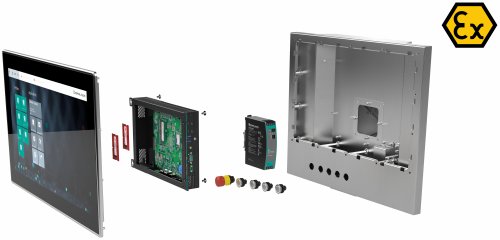
The modular platforms of the HMI portfolio from Pepperl+Fuchs offer individual solutions for applications ranging from non-hazardous areas to Zone 1.


Modular design of VisuNet FLX


The VisuNet GXP and VisuNet FLX HMI device families enable maximum flexibility for use in the process industry. The modular design allows HMI systems to be configured to meet precise individual needs, providing extremely quick, simple service options in the field. This means that a comprehensive range of technologies, installation options, and peripherals is available for customers. Each HMI system consists of at least one computer unit and one display unit, each of which can be individually configured. The operator workstations from Pepperl+Fuchs are designed and certified for use in ATEX/IECEx Zone 1/21, Zone 2/22, and Div 1 applications. In addition, all products can be used in non-hazardous areas.

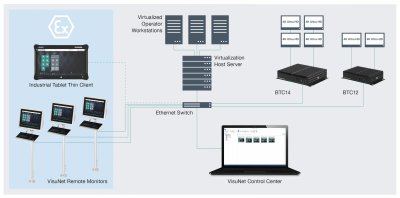
The VisuNet RM Shell 5 firmware developed by Pepperl+Fuchs for VisuNet thin clients is based on Windows 10 IOT 2019 LTSC and offers a simple way to make individual adjustments. The highest safety standards and flexible configuration options allow connection to numerous virtualized and conventional process control systems.


End-to-end thin client portfolio up to Zone 1/21


The product range is rounded off by rugged box thin clients for use in control rooms and switch cabinets. In addition, mobile tablet thin clients from Pepperl+Fuchs ensure a complete portfolio for virtualized and conventional process control systems. With the VisuNet Control Center software, the thin clients can be managed seamlessly and centrally — from Zone 1 to the control room.

NOW AVAILABLE! ATEX/IECEx Zone 1 iPhone 13


Benefits 

.self sim- installation  and change 

.NFC (near field communication 

.ATEX and IECEx certified zone 1 & 2

.Apple open DEP enrollment 

.New slim bumper design


Please refer to the link hereunder for a short product video presentation

https://youtube.com/shorts/V8_T4pyHI7s?feature=share


 Applications 

.Petro (Chemical ) plants 

.Offshore environments 

.Ex safe camera 

.Connected worker/Industry 4.0

.Digital twins at hazardous locations 

More info 

www.Atexxo.com


.


Double contract success for engineering company


22929351-C8AA-42D8-9616-A6690CD2F3C6.jpeg


AN INDEPENDENT engineering firm is celebrating winning two major nuclear contracts.

Cumbria-based Forth has secured two separate contracts to carry out work on behalf of governmental nuclear decommissioning company Magnox.

The team at Forth has successfully tendered to design, manufacture and provide waste retrieval solutions in Magnox wet vaults at Hinkley Point, and has also earned a separate contract to design and install active effluent pumping facilities at Magnox’s SGHWR and Dragon reactors in Winfrith.

Chris Downham, Forth’s operations manager, said: “Winning these contracts is a major deal for an SME like Forth, and we are delighted to have been selected for the work after a rigorous tendering process.

“Forth has proven over two decades that it can provide working solutions to industry problems across the world, and we will again showcase the capabilities of our fantastic team through this work with Magnox.

“We have demonstrated our expertise in coming up with answers to industry challenges, and we are excited to put the theory into practice and prevent persistent problems occuring.

“The work Magnox carries out is of global significance, and we’re thankful for the opportunity to assist with such groundbreaking projects.”

Linda Sapsford, Head of Procurement at Magnox, added: “We’re delighted to be collaborating with Forth as we safely decommission our sites at Hinkley and Winfrith

One of our goals at Magnox is to add social value by creating employment and supply chain opportunities around our sites and across the UK, so it’s great to be working with an innovative home-grown company.”

The wet vault retrieval project has been split into two areas: one to concentrate on HAI waste management and the other focused on water management.

The HAI management work will see the team supply a number of skips in the wet vaults with unique lifting arrangements as well as chutes to help segregate waste in the vault. Further to this, the team will produce a specially designed fuel box which can be controlled with a remotely operated vehicle or a long reach tool.

Forth will also be provided lighting rigs and live camera feeds to improve the usability of all equipment. 

The water management element of the contract has been divided into three sub-projects:

● To design extra pre-filtration units to support the existing systems;
● To produce a water recirculation system as an additional means of pumping vault water;
● To design and create a turbidity abatement system to remove contaminated water from the sorting tray in a controlled and timely manner.

For the active affluent pumping facilities contract, Forth will create a process where active liquor can be transferred from the SGHWR and Dragon reactors in the Winfrith plant to 1,250-litre intermediate bulk containers and taken off site to be safely disposed of.

Chris said: “The work to be carried out is complex but our expert teams have come up with great concepts, and they will rise to the challenges posed through these contracts.”

Forth has worked with Magnox a number of times in the past 12 months which included devising a robotic arm to sift through debris in hazardous environments and the creation of a remotely operated machine which could also remove waste from hazardous environments on a larger scale.