
News
Safeguarding Sterile Boundaries: Safe Remote Utility Auditing in ATEX and Cleanroom Environments
For pharmaceutical manufacturers, cleanrooms and ATEX-rated hazardous zones present some of the most challenging operating environments in modern industry. To maintain strict ISO cleanliness classifications and prevent cross-contamination, access to these controlled zones is heavily restricted. At the same time, compressed air systems, process gas lines, and electrical switchgear running inside these environments must be monitored constantly, since even a small leak or electrical fault can compromise safety, product integrity, or energy efficiency. To address these challenges, facilities are turning to remote ultrasonic acoustic imaging as a way to inspect hazardous and hard-to-reach areas without physically entering them.

The Hidden Cost of Compressed Air and Gas Leaks
Compressed air and process gases such as nitrogen are essential utilities in pharmaceutical manufacturing, used for pneumatic controls, purging, and formulation processes. Leaks in these systems are notoriously difficult to detect with the human ear, especially in noisy production areas or elevated piping runs. Left undetected, they translate directly into wasted energy, unstable process conditions, and unplanned maintenance work. In ATEX zones, tracking down a leak by ear or by hand-held contact methods is not only inefficient, it can require shutting down equipment or donning heavy protective gear just to get close enough to investigate.
Electrical Anomalies and Partial Discharge
Electrical switchgear and connections operating in cleanroom and hazardous environments are also vulnerable to partial discharge, corona, and tracking, early warning signs of insulation breakdown that can eventually lead to equipment failure or fire risk. Because these anomalies emit distinctive ultrasonic signatures, they can be detected long before they become visible or audible to a technician standing nearby, provided the right tool is used at a safe distance.
Safe Remote Inspection with Acoustic Imaging
Setting up ladders or wearing heavy protective suits to inspect elevated piping or electrical switchgear is slow, labor-intensive, and introduces contamination risks to sterile cleanrooms. Using an ATEX-certified CRYSOUND acoustic camera, maintenance teams can conduct safe, non-contact remote inspections of both compressed air/gas systems and electrical assets.
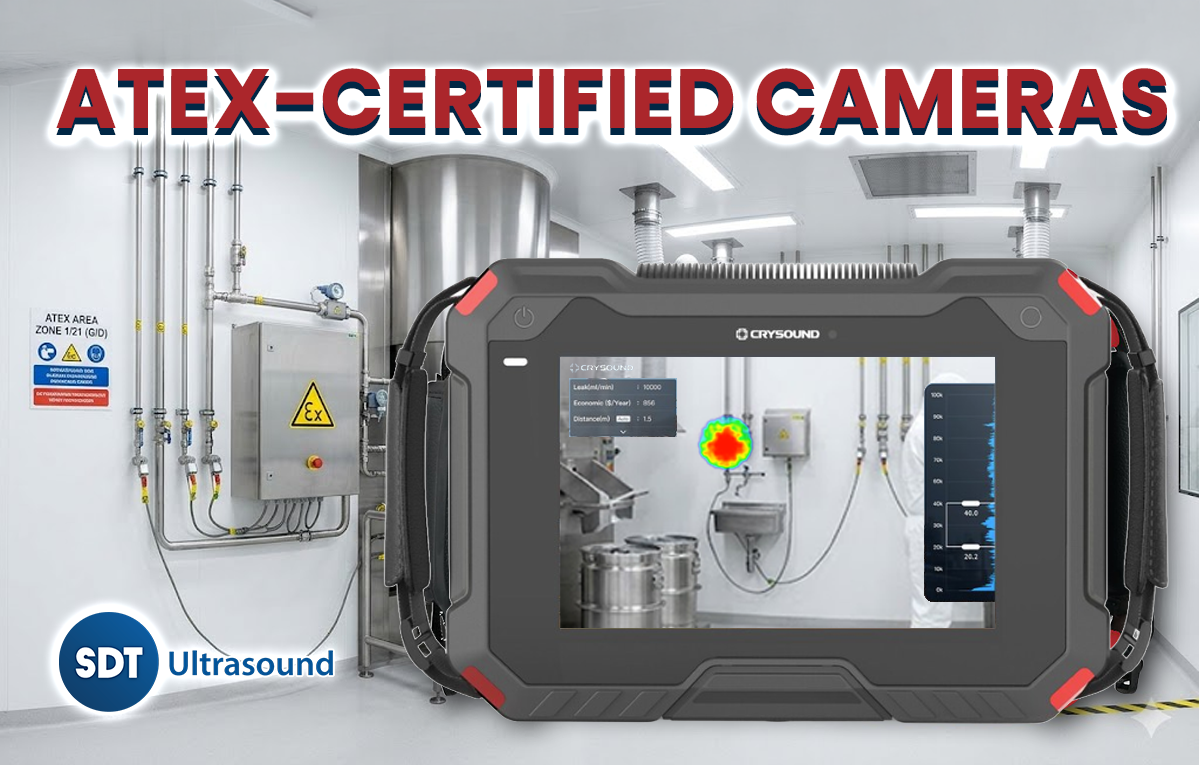
These acoustic cameras use high-performance MEMS microphone arrays to convert ultrasonic sound waves into a color-coded visual "bloom" displayed on a real-time optical screen. This visual feedback allows technicians to locate and document compressed air leaks, nitrogen leaks, vacuum bypasses, or electrical partial discharge from a safe distance of up to 200 meters, completely eliminating the need to enter restricted zones, climb infrastructure, or interrupt active production.
Because inspections are non-contact and can be performed from outside the immediate hazard area, they also reduce the risk of introducing particulates or contamination into sterile cleanroom zones.
Conclusion
Maintaining energy efficiency and electrical safety in ATEX and cleanroom environments requires visibility into problems that are otherwise invisible and inaudible. By adopting remote ultrasonic acoustic imaging, pharmaceutical manufacturers can detect compressed air and gas leaks, identify electrical anomalies before they escalate, and protect both personnel and product, all without compromising cleanroom integrity or hazardous area safety.
For more information, scan: