
MIT World: Engineering >>
 It’s a good thing for a world increasingly beset by mammoth challenges that universities are responding with new engineering systems programs. These initiatives, as Daniel Roos attests, are swiftly proliferating in the U.S. and abroad to equip students to address such complex issues as health care, sustainable energy, and infrastructure. Roos celebrates the fifth year of the Council of Engineering Systems Universities (CESUN), one of this symposium’s sponsors, and recaps his survey of group members on the state of engineering systems education.
While some traditionalists resist the interdisciplinary dimensions and broad compass featured so prominently in engineering systems programs, Roos believes that rapid global change necessitates corresponding change in how engineers are trained to think and practice. A case in point: a collapsing 100-year-old automobile and transportation system whose revival must incorporate complex, networked systems: intelligent infrastructure that can improve safety and alleviate congestion; and new, green, digitally wired vehicles integrated in a “smart energy net.”
ESD researchers study the complex social/technological questions that “will increasingly determine the future,” says Susan Hockfield. At MIT, Hockfield's job “is to lower boundaries that still exist between departments, and schools. By bringing
It’s a good thing for a world increasingly beset by mammoth challenges that universities are responding with new engineering systems programs. These initiatives, as Daniel Roos attests, are swiftly proliferating in the U.S. and abroad to equip students to address such complex issues as health care, sustainable energy, and infrastructure. Roos celebrates the fifth year of the Council of Engineering Systems Universities (CESUN), one of this symposium’s sponsors, and recaps his survey of group members on the state of engineering systems education.While some traditionalists resist the interdisciplinary dimensions and broad compass featured so prominently in engineering systems programs, Roos believes that rapid global change necessitates corresponding change in how engineers are trained to think and practice. A case in point: a collapsing 100-year-old automobile and transportation system whose revival must incorporate complex, networked systems: intelligent infrastructure that can improve safety and alleviate congestion; and new, green, digitally wired vehicles integrated in a “smart energy net.”
ESD researchers study the complex social/technological questions that “will increasingly determine the future,” says Susan Hockfield. At MIT, Hockfield's job “is to lower boundaries that still exist between departments, and schools. By bringing
 These panelists use the lens of systems engineering to focus sharply on some signature global challenges in finance, healthcare, energy and IT.
  One of the nation’s revered technology leaders dispenses anecdotes and wisdom on the slippery subject of engineering systems (or systems engineering). Norm Augustine just can’t get a handle on the discipline: “No one agrees on what it is, or what it does.” After years in industries like Lockheed Martin, Augustine has come up with “Norm’s Rules,” and can at least define ‘system’ as “having two or more elements that interact,” and ‘engineering’ as “creating the means for performing useful functions.” But these definitions don’t get you too far in the real world.
 The field of systems engineering has only recently emerged, and as this symposium demonstrates, defies precise definition. But MIT has taken this evolving area to heart, nurturing a new division and encouraging a raft of ventures that in their execution, may help shape the field for the next century.
 Real-world practitioners of systems engineering/engineering systems describe how the young discipline has shaped their very large enterprises.
  Astronaut Mike Massimino returns to MIT and shares his experience on the Space Shuttle Atlantis (STS-125). Topics include the challenges of space walking while repairing the Hubble, having the right tools on hand for high stakes repairs, and the long hours of practice that lead up to the task.
 It’s no exaggeration to say John Holdren’s job involves tackling the most critical issues of our age: economic recovery and growth, health care, energy, climate change, global pandemics, national security, ecosystem preservation…the list goes on. As President Obama’s science and technology advisor, Holdren leverages the resources and collective acumen of the nation’s researchers and innovators to address these complex and urgent matters. At an MIT AeroAstro hosted event, Holdren makes the case that aerospace science, technology and education will provide a “crucial contribution to and driver of many relevant capabilities” the U.S. will need to meet this century’s challenges.
  Road traffic is a challenging societal problem, and with the increasing crowding of areas in and around cities, it is only becoming worse. With the proliferation of wireless connectivity, smartphones (think cheap embedded computers), it is now possible to continuously monitor urban areas using mobile sensors carried by people while they drive.
 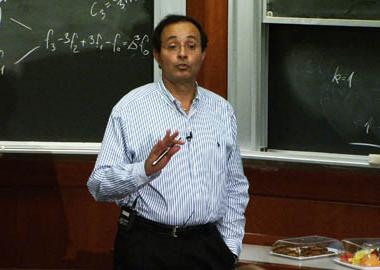 The need for flexible management of supply chains to increase operational efficiencies could not be greater, as modern companies outsource and manufacture overseas. David Simchi-Levi observes that between 2003 and 2008 labor costs increased by 21% in Brazil, 19% in China, and 3% to 8% in other countries. Meanwhile, logistic costs, as a percentage of gross domestic product (GDP), began to rise in 2003, after declining steadily. Adding to this unstable business mix has been tremendous volatility and fluctuation in oil prices.
 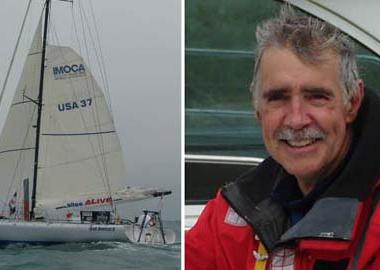 Rich Wilson had followed the Vendée Globe Race ('round-the-world single-handed) since its inception in 1988 but had never considered sailing it himself—“too hard, too long, too dangerous, too risky, too, too, too, the boats were too big, the sails were too big.”