
News
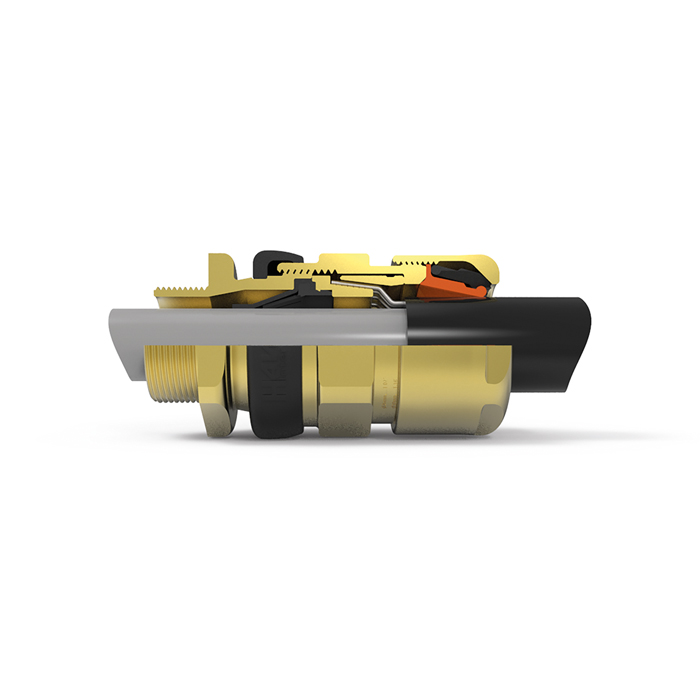
Small Part, Big Difference - The Importance of Cable Glands
Here, Matt Ogden, Cable Gland Product Specialist at Hawke International, discusses the vital role that cable glands play when it comes to protecting expensive equipment, and the factors companies must consider in order to implement an effective cable gland strategy.
All too often, people think of cable glands as being mere commodity products, but dismissing them as bits of brass and rubber seriously underestimates their value. The fact is, they play a fundamental role in protecting some of the most important machinery found in any factory, safeguarding electrical, instrumentation and control, and automation systems.
Why use Cable Glands?
The main function of a cable gland is to act as a sealing and terminating device, to ensure the protection of electrical equipment and enclosures, including the provision of:
Environmental Protection – by providing a seal on outer cable sheaths, preventing dust and moisture from getting into an enclosure.
Holding Force – on the cable to ensure an adequate level of mechanical cable ‘pull out’ resistance.
When used in hazardous environments in particular, it is essential that cable glands are approved for the selected type of cable and that they maintain the level of protection of the equipment which they are attached to.
With this in mind, what factors do companies need to consider?
Over and Under Tightening
Businesses must invest in cable glands that have tightening guides as standard. This gives the glands’ installer and inspector a simple visual indicator to show it has been tightened correctly to the outer diameter of the cable being fitted.
This is worth stressing as cable glands that are over or under tightened will not last their full lifespan. More importantly, they will be limited in their ability to offer ingress protection against dust and water penetration; with an over tightened gland compromising a cable’s properties, and an under tightened gland loosening. Also, a compromised cable presents an explosion risk, and a loose one creates an electric shock risk; both of which must be avoided at all costs.
Cable Vulnerability to Pulling, Twisting and Tightening
Cables can pull away if an incident happens with a gland, and damage to equipment can be sustained, but this can be prevented by installing a cable clamp or cleat within 300mm of the end of a cable gland. This ensures that if any extreme pulling, twisting or tightening of a cable occurs, the required strain-relief is provided, mitigating any extra damage.
A lack of knowledge, as well as space onsite, means that many installations do not adhere to this standard. There are, however, innovations available that should be considered as part of any cable gland strategy.
Installation
It’s always advisable to use glands that come with a full training service. This is because poorly installed cable glands present a serious threat; expensive equipment failures will happen if installation practices are negligent.
Invest in the Protection of Machinery
Cable glands are tasked with working in testing conditions, especially when used in hazardous environments. Every item of equipment in such settings – no matter how small – must play its part. This absolutely includes cable glands. If glands fail to do their job, the consequences can be catastrophic and equipment worth hundreds of thousands of pounds will be damaged.
By thinking about and developing an effective cable gland strategy, organisations will save themselves a lot of hassle in the long run. It’s imperative that senior decision-makers understand the significance of cable glands and take the implementation of a cable gland strategy seriously from the offset.
Hawke International is a market leading manufacturer of cable glands for harsh and hazardous environments. For further information on reviewing your cable gland strategy, visit www.hubbell.com/hawke, call +44 (0) 161 830 6695 or email This email address is being protected from spambots. You need JavaScript enabled to view it.
