
Latest Videos
Perceptive Mobile Robots Working Safely Alongside Humans
MIT World: Engineering >>
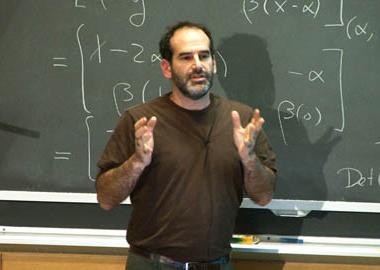 Although we are still far from the moment of singularity, or even Star Wars ‘droids, we can anticipate robot colleagues in the near future, believes Seth Teller. He is developing ‘situationally aware’ machines to help out humans in those “unstructured environments…where we live, work and recreate.”
Teller’s goal is not “to solve the full AI problem,” but to provide robot solutions to specific challenges. Whatever the project, the robot must successfully navigate a messy human world with appropriate sensor data, and interact with us on our terms, through speech and gestures, overcoming potential unease. “We are working with ways of creating natural interactions between humans and robots, paying attention to notions of human acceptance,” says Teller.
The first venture Teller describes is an unmanned car, developed for a DARPA competition. Teller’s team had to design a vehicle that could not only “see” around itself, but understand the rules and hazards urban driving. Teller shows video of the “Urban Challenge” finals, with his car waiting patiently at an intersection for another car to pull out –“no honking or obscenities,” he notes. Someday, believes Teller, such a vehicle could help reduce U.S.
For more techical information visit our sister website www.engineeringmaintenance.info or for equipment procurement please visit www.engineeringtrader.com

Although we are still far from the moment of singularity, or even Star Wars ‘droids, we can anticipate robot colleagues in the near future, believes Seth Teller. He is developing ‘situationally aware’ machines to help out humans in those “unstructured environments…where we live, work and recreate.”Teller’s goal is not “to solve the full AI problem,” but to provide robot solutions to specific challenges. Whatever the project, the robot must successfully navigate a messy human world with appropriate sensor data, and interact with us on our terms, through speech and gestures, overcoming potential unease. “We are working with ways of creating natural interactions between humans and robots, paying attention to notions of human acceptance,” says Teller.
The first venture Teller describes is an unmanned car, developed for a DARPA competition. Teller’s team had to design a vehicle that could not only “see” around itself, but understand the rules and hazards urban driving. Teller shows video of the “Urban Challenge” finals, with his car waiting patiently at an intersection for another car to pull out –“no honking or obscenities,” he notes. Someday, believes Teller, such a vehicle could help reduce U.S.
driving fatalities, improve gas mileage and human productivity, and even replace thousands of military ground vehicles.
Teller has also been applying the principles of autonomous mobility to logistics in the form of an unmanned forklift for the military. Typical robotic forklifts function in indoor warehouses with smooth floors, uniform lighting, precise maps. Teller’s challenge was to come up with a device the “military could set down in a patch of earth somewhere.” This forklift robot is equipped not just with laser scanners to detect fixed or moving obstacles, but microphones, so it can stop if it hears a command or shouting. It also displays “text strings and color kinetic LEDs” to let people know where it is going.
Teller is applying this kind of machine intelligence to aid severely disabled people, with a motorized wheelchair that lets users navigate around an institutional setting, learning to map a space using verbal labels from a human trainer. A related assistive technology may offer blind people the possibility of greater independence and efficiency. Teller imagines a device that can “build up a persistent model of the wearer’s surround,” which could let a blind person know where she left her keys, or send out spoken or braille navigational instructions. Together, these projects point toward machine minds that can increasingly interpret human commands and needs, achieving “validation” from human supervisors and Teller hopes, “a gradual path toward autonomy.”...Read the full article/Watch Video
Teller has also been applying the principles of autonomous mobility to logistics in the form of an unmanned forklift for the military. Typical robotic forklifts function in indoor warehouses with smooth floors, uniform lighting, precise maps. Teller’s challenge was to come up with a device the “military could set down in a patch of earth somewhere.” This forklift robot is equipped not just with laser scanners to detect fixed or moving obstacles, but microphones, so it can stop if it hears a command or shouting. It also displays “text strings and color kinetic LEDs” to let people know where it is going.
Teller is applying this kind of machine intelligence to aid severely disabled people, with a motorized wheelchair that lets users navigate around an institutional setting, learning to map a space using verbal labels from a human trainer. A related assistive technology may offer blind people the possibility of greater independence and efficiency. Teller imagines a device that can “build up a persistent model of the wearer’s surround,” which could let a blind person know where she left her keys, or send out spoken or braille navigational instructions. Together, these projects point toward machine minds that can increasingly interpret human commands and needs, achieving “validation” from human supervisors and Teller hopes, “a gradual path toward autonomy.”...Read the full article/Watch Video
For more techical information visit our sister website www.engineeringmaintenance.info or for equipment procurement please visit www.engineeringtrader.com
