
Latest Videos
Data-driven Traffic Modeling, Prediction, and Planning
MIT World: Engineering >>
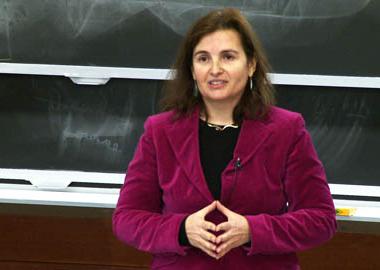 Some professors work primarily in labs, and others mainly at desks. Daniela Rus conducts her research on the bustling streets of Singapore, where she is helping to design a “future mobility project” whose goal is to “marry information technology with the transportation industry.” This venture aims to improve urban passenger and freight transportation, addressing issues of gridlock and other traffic frustrations – a giant step toward a more rational, sustainable travel system.
Rus’s work, part of the Singapore-MIT Alliance for Research and Technology, involves piloting a “mobility on demand” transport network on a campus springing up to host foreign research groups. Part of this vision involves creating autonomous robot vehicles (golf carts with brains) that can sense their way with laser scanners and GPS to pick people up at one point, and drop them off at another. These robots must navigate their way through a densely populated human environment, avoiding collisions and timing departures and arrivals with precision. Fleets of lightweight vehicles figure in the dream of making cities greener by decreasing private vehicle use.
In addition, as part of this multi-phase project, Rus and her collaborators are
For more techical information visit our sister website www.engineeringmaintenance.info or for equipment procurement please visit www.engineeringtrader.com

Some professors work primarily in labs, and others mainly at desks. Daniela Rus conducts her research on the bustling streets of Singapore, where she is helping to design a “future mobility project” whose goal is to “marry information technology with the transportation industry.” This venture aims to improve urban passenger and freight transportation, addressing issues of gridlock and other traffic frustrations – a giant step toward a more rational, sustainable travel system. Rus’s work, part of the Singapore-MIT Alliance for Research and Technology, involves piloting a “mobility on demand” transport network on a campus springing up to host foreign research groups. Part of this vision involves creating autonomous robot vehicles (golf carts with brains) that can sense their way with laser scanners and GPS to pick people up at one point, and drop them off at another. These robots must navigate their way through a densely populated human environment, avoiding collisions and timing departures and arrivals with precision. Fleets of lightweight vehicles figure in the dream of making cities greener by decreasing private vehicle use.
In addition, as part of this multi-phase project, Rus and her collaborators are
collecting and analyzing vast amounts of data on current traffic patterns in Singapore, with the goal of “maximizing the experience in traffic.” Accessing GPS information from Singapore’s 16 thousand taxis, her group gathered data logged at one-minute intervals on taxi speed, location, and occupancy. “This rich data set for the entire country is a source of joy for me and my colleagues,” says Rus. This information showed traffic spikes, and the most frequent origins and destinations – “an interesting way of seeing what everyone in Singapore is up to.”
With data gathered from roadbed detectors as well, Rus built up predictions about how taxi and general traffic moved from day to day, and then came up with algorithms for mapping “congestion aware routing,” not just for single users, but for the entire city. Says Rus, “The system computes different paths according to different times of day,” and can” help cars get from one point to another without getting stuck.” Rus proudly relates that her algorithm works better “than the simple searches Google supports.”
In the final phase of the project, says Rus, autonomous robot cars will be deployed carrying onboard navigation systems for sensing and predicting traffic patterns, picking up and dropping off riders at stations so as to minimize wait times, and generally moving where needed “in a congestion aware way.”...Read the full article/Watch Video
With data gathered from roadbed detectors as well, Rus built up predictions about how taxi and general traffic moved from day to day, and then came up with algorithms for mapping “congestion aware routing,” not just for single users, but for the entire city. Says Rus, “The system computes different paths according to different times of day,” and can” help cars get from one point to another without getting stuck.” Rus proudly relates that her algorithm works better “than the simple searches Google supports.”
In the final phase of the project, says Rus, autonomous robot cars will be deployed carrying onboard navigation systems for sensing and predicting traffic patterns, picking up and dropping off riders at stations so as to minimize wait times, and generally moving where needed “in a congestion aware way.”...Read the full article/Watch Video
For more techical information visit our sister website www.engineeringmaintenance.info or for equipment procurement please visit www.engineeringtrader.com
