
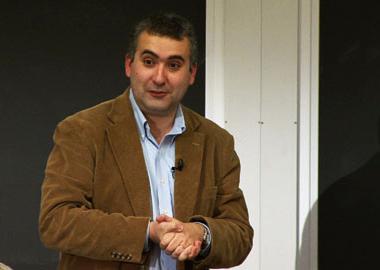
 If you had half a million dollars, would you opt for a passenger car that could drive itself (called an autonomous vehicle) or would you choose a new Ferrari? Emilio Frazzoli provides a number of reasons why autonomous vehicles might be the preferred choice, if not the typical one. Autonomous vehicles, that use electronics in place of human drivers, will offer many improvements for urban mobility. Frazzoli says they will advance the safety and comfort of automotives- and open the doors of mobility for people who cannot or should not drive; as he puts it, “if you had too much to drink, maybe you should let the computer take you home.” Future autonomous vehicles can also increase the efficiency and throughput of our existing road system and help reduce congestion by coordinating with others cars. The autonomous vehicle will also be a “green vehicle” that can make more fuel-efficient decisions than human drivers. Future autonomous vehicles might save up to 20 to 50% of emissions and fuel consumption by optimizing speed and stopping.
 In some ways, the autonomous vehicle is already with us. There
are robotic components in the cars we drive today, like ABS (advanced breaking systems) which takes over control from human drivers to stop cars and avoid collisions. Frazzoli says that when ABS first reached the market it was a novelty and good drivers felt they could stop faster than the system. Today, it is widely accepted that it performs better than almost everyone except a Formula 401 racer. More recently, autonomous components enable cars to park themselves, and in the arena of mass transportation, there are autonomous bus demonstrations, and driver-less shuttles. Frazzoli sees the demand for autonomous vehicles as only growing. The autonomous vehicle can address the problem that both drivers and passengers are becoming increasingly distracted on the road with cell phones and electronics. And, with a growing network of V- 2- V (vehicle to vehicle) communications, autonomous vehicles can coordinate with other cars, beyond the capabilities of individual drivers. Simply put, human drivers can only account for vehicles they can see, while an autonomous vehicle has the advantage of synchronizing with the entire network upstream and downstream.
Some initial work on autonomous vehicles began in the 1980’s. More recently it has captured the imagination of the US Defense Department whose DARPA program has set million dollar prize challenges. Frazzoli gives some firsthand lessons from participating in the highly coveted DARPA vehicle challenge of 2007. Initially there were 89 teams but only 7 teams, including MIT, made the final cut. The road conditions were very realistic and each vehicle team had to navigate as an urban vehicle in regular traffic. In other words, the autonomous vehicle needed to abide by the rules of the road, obey speed limits, merge into traffic, pass safely and avoid obstructions. Frazzoli jokes,” the vehicle had to have enough skills to qualify for a California drivers license”. The MIT team equipped a Land Rover LR3 with state- of –the- art- technology that included more than 40 CPUs, radar, and a myriad of laser like sensors, rotating scanners, and video cameras. Two main modules were a perception sub system, which figured out where the road was, and a planning control system, which then used a decision tree algorithm to anticipate and adhere to rules- of- the- road. Only six vehicle teams (including MIT) actually finished the race. According to Frazzoli, “the race was so successful that the only way you could detect that an autonomous vehicle was driving, was that each robotic driven car had a human driver close behind it with a remote control (in hand).”...Read the full article/Watch Video
Some initial work on autonomous vehicles began in the 1980’s. More recently it has captured the imagination of the US Defense Department whose DARPA program has set million dollar prize challenges. Frazzoli gives some firsthand lessons from participating in the highly coveted DARPA vehicle challenge of 2007. Initially there were 89 teams but only 7 teams, including MIT, made the final cut. The road conditions were very realistic and each vehicle team had to navigate as an urban vehicle in regular traffic. In other words, the autonomous vehicle needed to abide by the rules of the road, obey speed limits, merge into traffic, pass safely and avoid obstructions. Frazzoli jokes,” the vehicle had to have enough skills to qualify for a California drivers license”. The MIT team equipped a Land Rover LR3 with state- of –the- art- technology that included more than 40 CPUs, radar, and a myriad of laser like sensors, rotating scanners, and video cameras. Two main modules were a perception sub system, which figured out where the road was, and a planning control system, which then used a decision tree algorithm to anticipate and adhere to rules- of- the- road. Only six vehicle teams (including MIT) actually finished the race. According to Frazzoli, “the race was so successful that the only way you could detect that an autonomous vehicle was driving, was that each robotic driven car had a human driver close behind it with a remote control (in hand).”...Read the full article/Watch Video
For more techical information visit our sister website www.engineeringmaintenance.info or for equipment procurement please visit www.engineeringtrader.com
